
Head of the Laboratory
Yuri Ivanovich Sukharnikov, Doctor of Technical Sciences, Professor of Metallurgy
Staff: 4 employees, including 1 Doctor of Technical Sciences, 1 Master's degree holder, and 1 Lead Engineer.
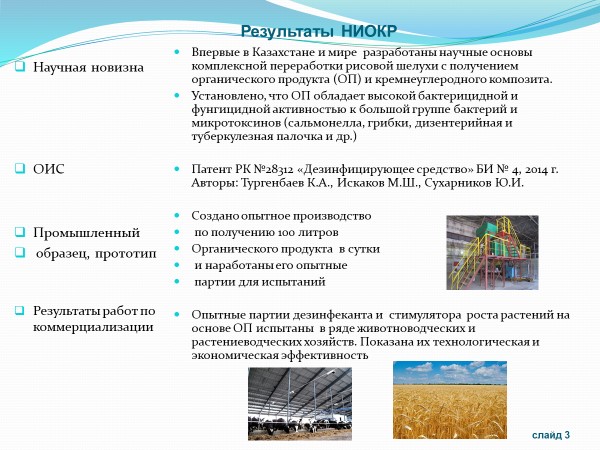
Research Profile
Development of innovative technologies for the integrated processing of rice production waste to obtain novel multifunctional materials and their application in various fields of engineering and agriculture.
Main Scientific Focus Area
Integrated processing of anthropogenic plant-based raw materials.
Developed Technologies
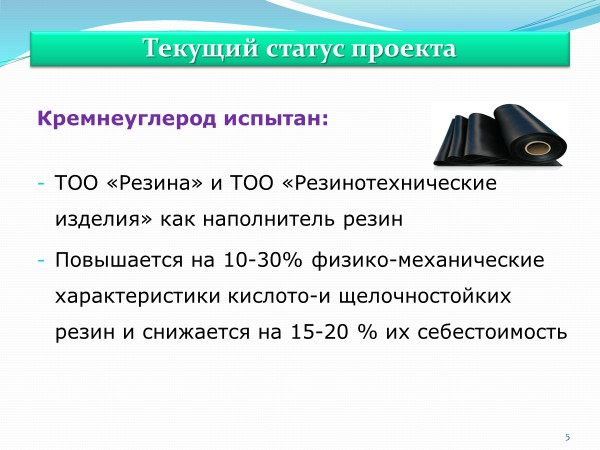
- Technology for the integrated processing of rice husk to obtain silicon-carbon (SiC-C) composite and organic product (OP), with applications of the OP as a feed additive in poultry farming, as a filler in rubber and structural carbon materials, and as a disinfectant in veterinary practice and plant growth stimulant in agriculture.
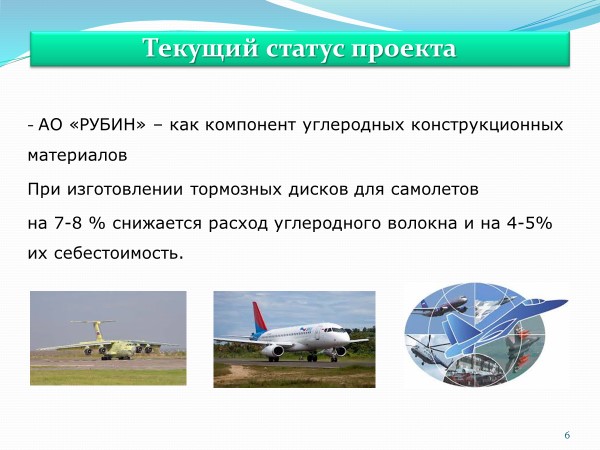
- Plasma-chemical technology for the production of a β-modification silicon carbide–carbon composite for use as a component in friction carbon materials.
Technical Equipment
- Laboratory setups for thermal processing of rice husk: Electric furnace-1-6-2.5, 2015; Muffle furnace -10 P, 2013; High-temperature furnace – 1750˚C, LHT 04/17, TMAX/1750, 2019; Disc grinder – ID-65, 2021
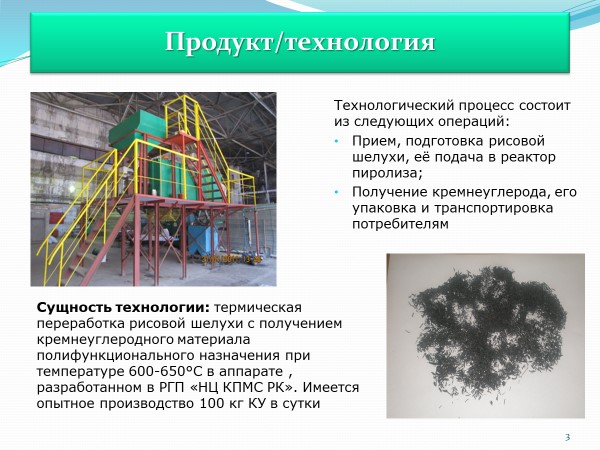
- Pilot-scale production facility (rotary kiln L–3 m, Ø–0.3 m) for silicon-carbon production (capacity: 100 kg/day), 2010
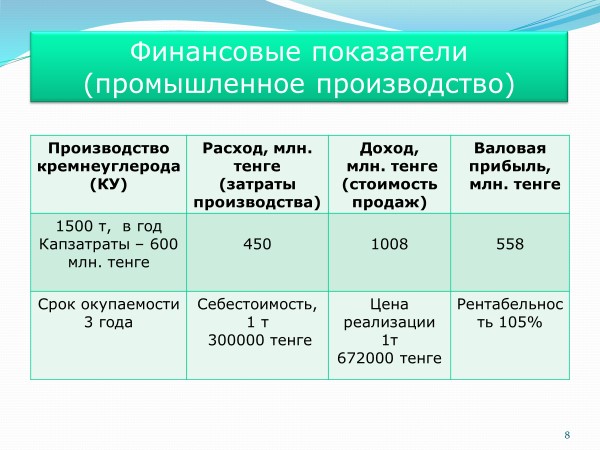
- Industrial-scale production of 1,500 tons of silicon-carbon per year, comprising a system of rice husk pyrolysis units, silicon-carbon cooling modules, pyrolysis gas recovery units, and packaging and final product separation equipment.
Publications, Patents, Standards, and Regulations
- A total of 106 scientific articles have been published and 21 patents of the Republic of Kazakhstan have been granted in the laboratory’s field of research
- Organizational standards developed: ST01-23 RGP-06-2015 “Silicon-carbon from rice husk”; ST 01-22-2.10 “Organic product from rice husk”; ST 01-23-RGP-06-2-14 “Silicon dioxide from rice husk”; ST 01-23-RGP-08-2014 “Graphitic carbon from rice husk”
- Technological regulation developed: VTR-1-2016 “Production of silicon-carbon from rice husk”
Contact Information
 Address Address |
Republic of Kazakhstan, Almaty, Zhandosov St., 67 |
 Phone Phone |
+7-727-2500070 (ext. 125) |
 E-mail E-mail |
This email address is being protected from spambots. You need JavaScript enabled to view it. This email address is being protected from spambots. You need JavaScript enabled to view it. |
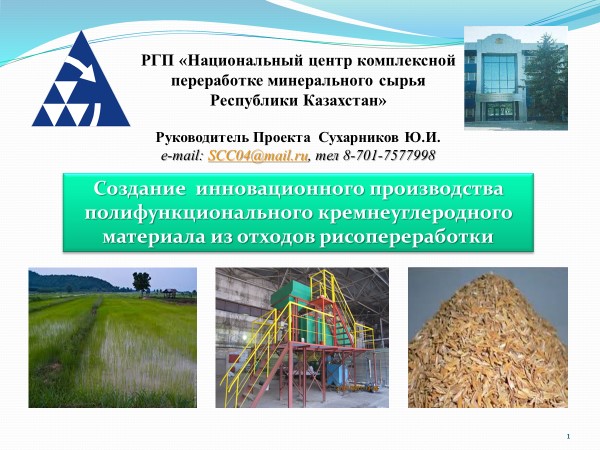
PRODUCTION OF NEW MULTIFUNCTIONAL MATERIALS FROM RICE PROCESSING WASTE
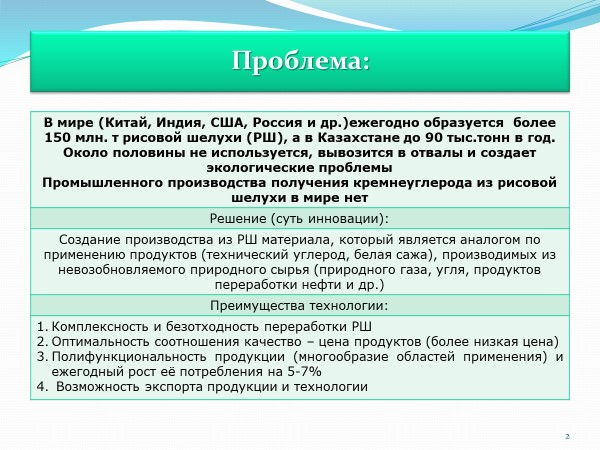
Global rice processing generates several million tons of rice husk annually, including approximately 60,000 tons in Kazakhstan. The majority of this rice husk remains unused and is discarded, causing environmental concerns.
The RSE "National Center on Compleex Processing of Mineral Raw Materials" has developed, for the first time in Kazakhstan and globally, a method and equipment for the thermal processing of rice husks (Patent of the Republic of Kazakhstan No. 34661 dated June 7, 2019, and Patent No. 8997 dated April 12, 2024), resulting in the production of silicon-carbon and an organic product.
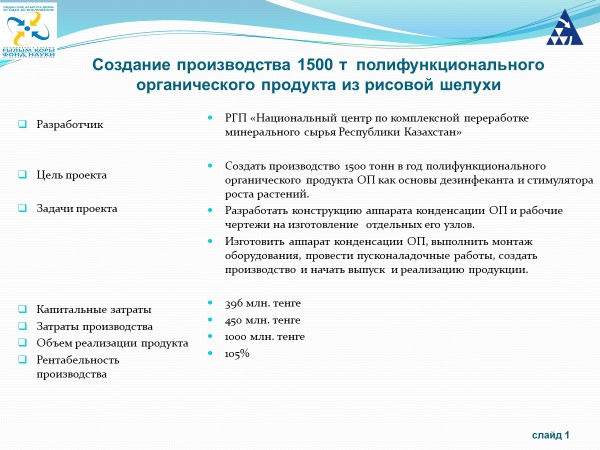
We have established a production facility with an annual processing capacity of 4,200 tons of rice husks, yielding 1,500 tons of silicon-carbon and 1,500 tons of organic product. Commercial production is scheduled to commence in Q4 of 2025.
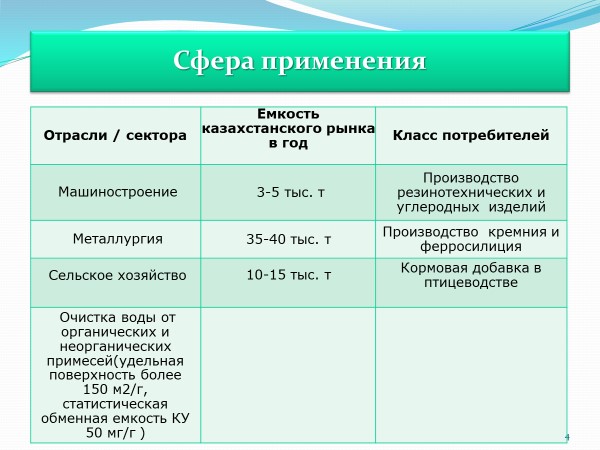
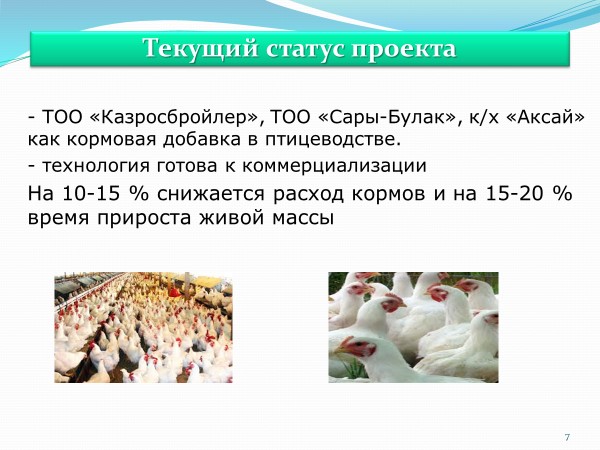
Silicon-carbon can be used as a biologically active feed additive in poultry farming, leading to increased productivity and reduced feed consumption.
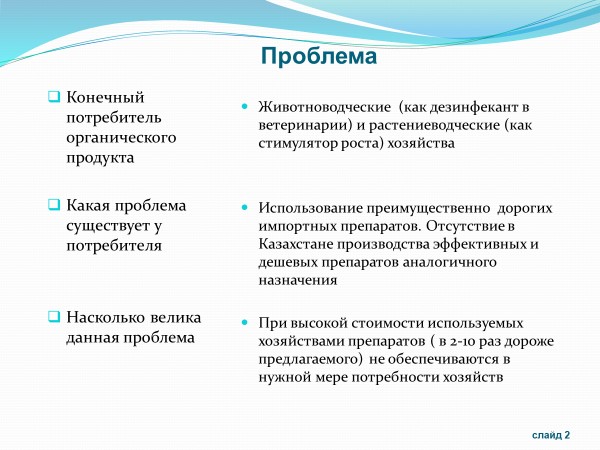
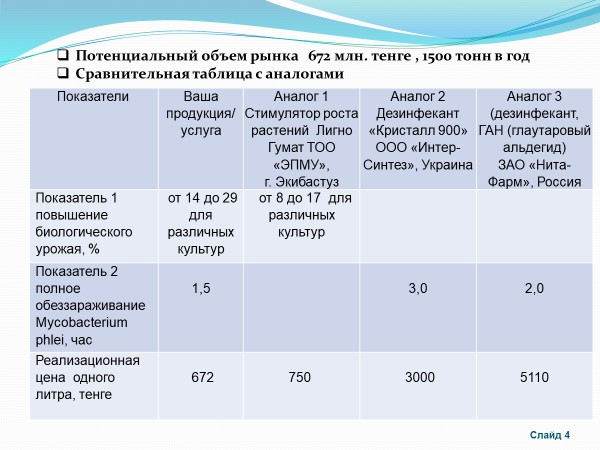
Aqueous solutions of the organic product can be utilized as a disinfectant in veterinary applications and as a growth stimulant in crop cultivation.
The total demand for silicon-carbon in Kazakhstan is estimated at 20,000 tons per year, while the demand for the organic product exceeds 5,000 tons annually.
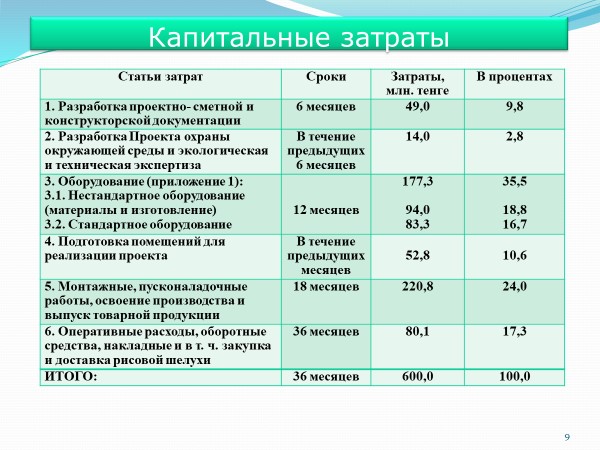
The capital investment required for establishing a production facility with an annual processing capacity of 4,200 tons of rice husks amounts to KZT 693 million.
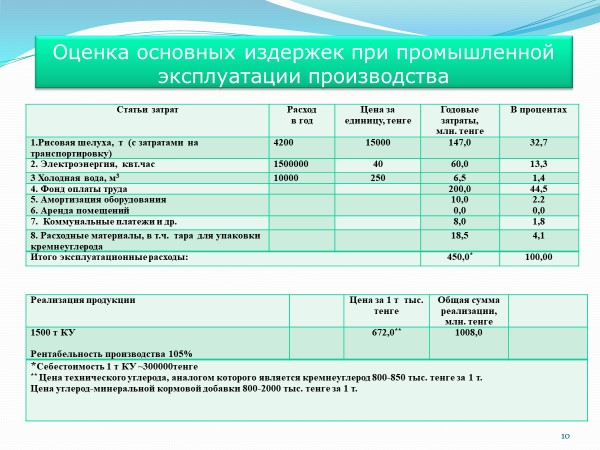
The annual operating costs for producing 1,500 tons of silicon-carbon (SC) and 1,500 tons of organic product (OP) are estimated at KZT 900 million.
Projected revenue from product sales totals KZT 2,088 million. The total annual profit is projected at KZT 1,188 million, with a production profitability rate of 112%.
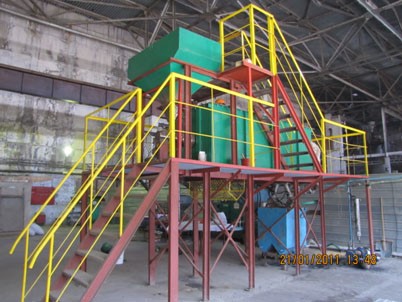
A pilot-scale facility has been established for the processing of rice husks, with a daily output capacity of 100 kg of silicon-carbon and 100 kg of organic product
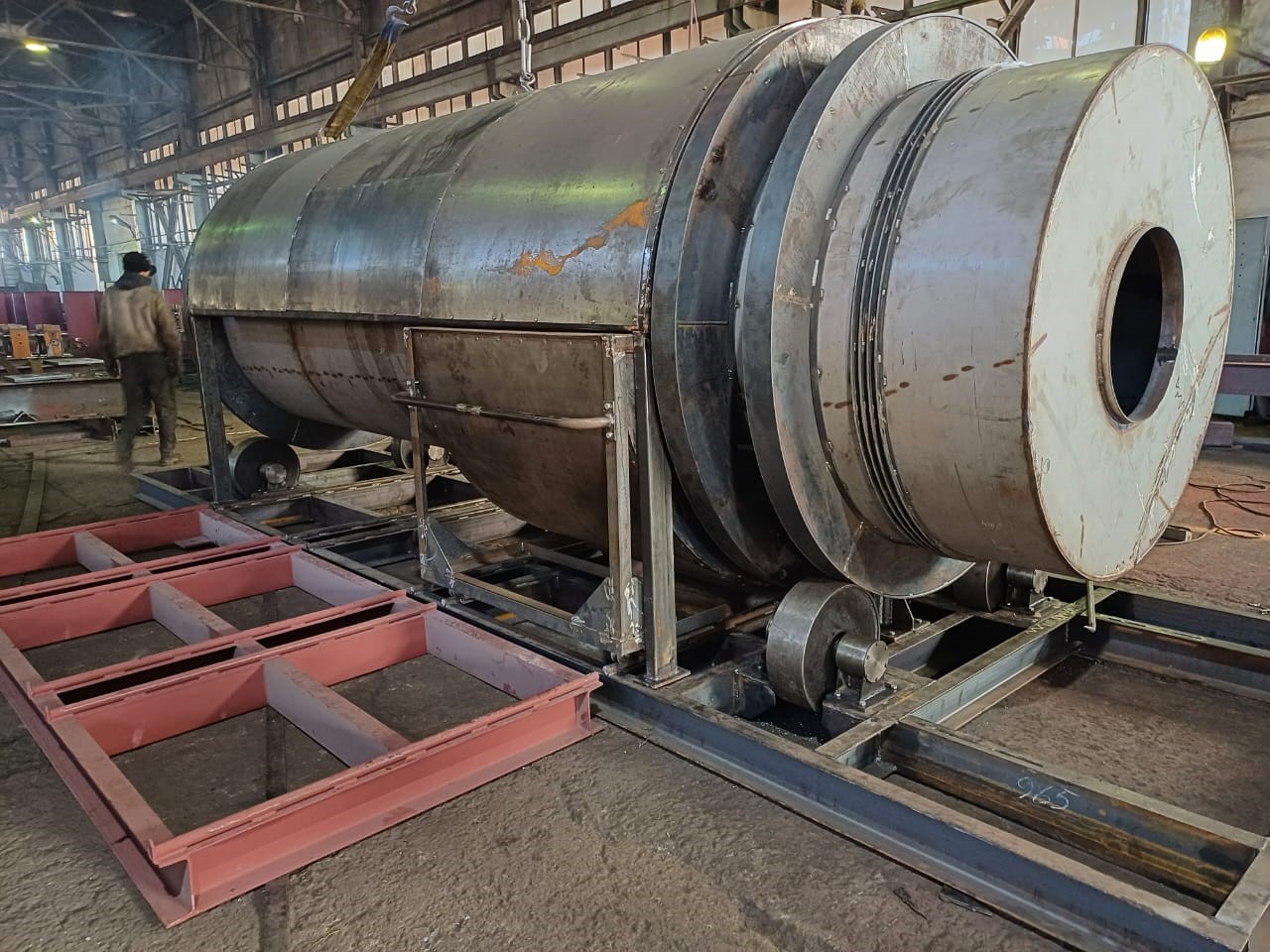
Rice Husk Pyrolysis Unit (4,200 tons/year) (4,200 tons/year)
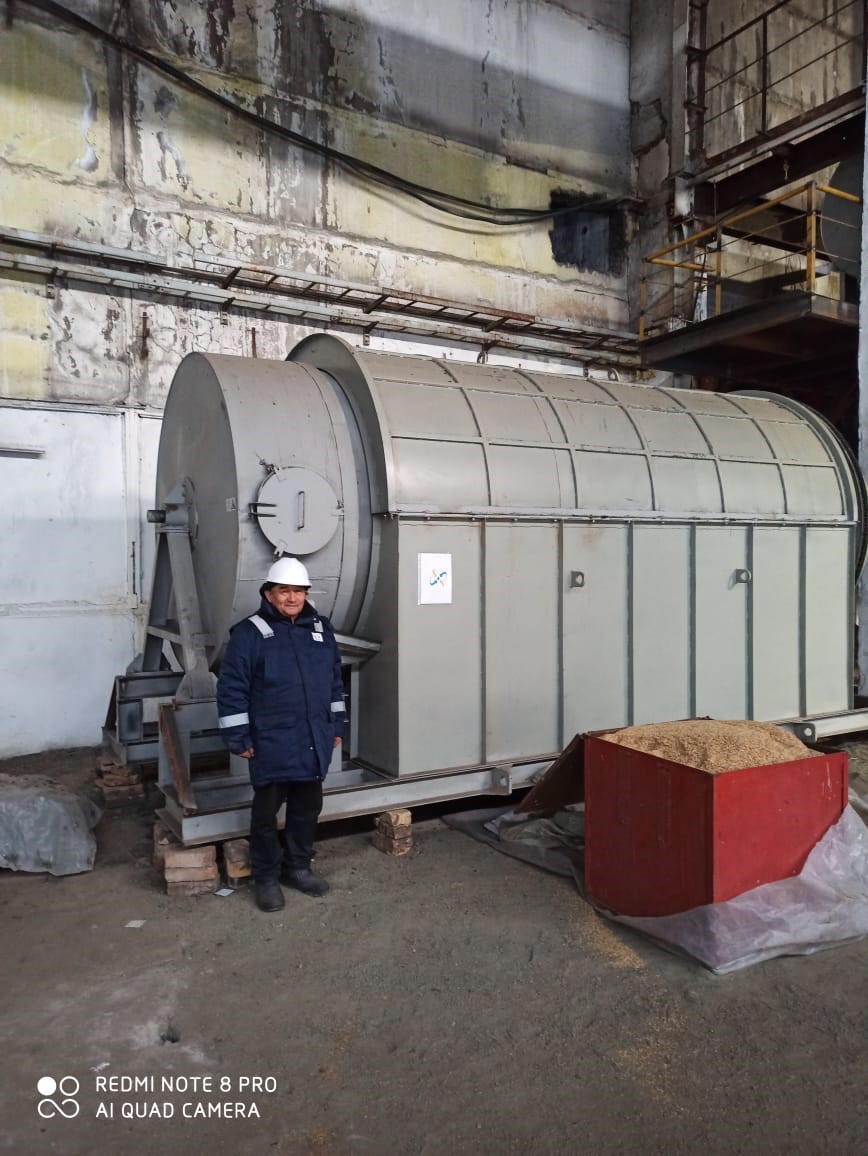
Silicon-Carbon Cooling Unit (1,500 tons/year)